How to… · How-to guide
Check the evidence behind a connection
Open the receipt behind any connection CityScroll draws, read what it does and does not claim, and keep a link that reopens the same receipt.
Why does this say two records are connected?
What this is for
CityScroll links records to each other: an agency to a rule, an agency to a contract, an organization to an award. Every one of those links can be opened up and inspected, so you never have to take a connection on trust.
This page shows you how, using one real connection on the Parks and Recreation page.
Before you start
- No account is needed.
- The connection panel is drawn in the browser, so this needs JavaScript switched on. Without it the records themselves still read normally; the panel simply does not appear.
Open one connection
- Open the Parks and Recreation page.
- Find the section headed Connected records and pick any entry in it.
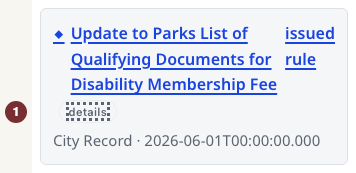
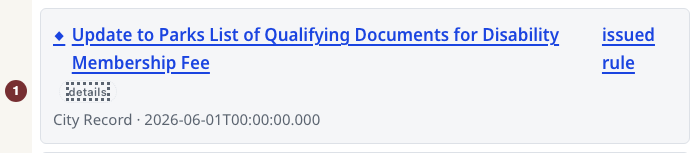
- Each entry carries a small control labelled details, which a screen reader announces as View connection details.
- Press it. A panel headed Connection evidence opens underneath.
To skip straight to the one this page describes, open the rule connection on the Parks page. It arrives with the panel already expanded.
Checkpoint: a panel headed Connection evidence is open, and it names one specific record rather than the whole page.
Read the receipt
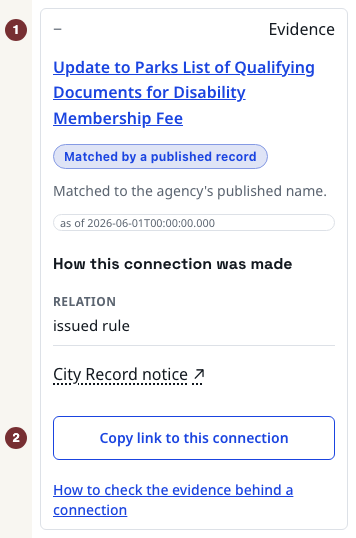
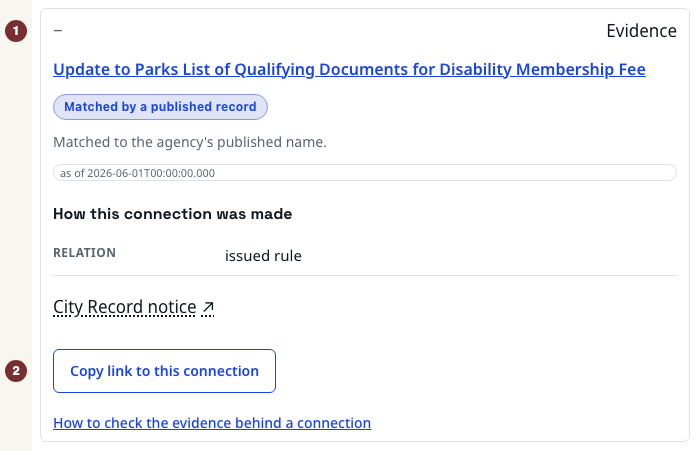
For that rule connection the panel holds five things, and each answers a different question.
- The record at the other end — Update to Parks List of Qualifying Documents for Disability Membership Fee — which you can open.
- How firm the link is: Matched by a published record. That is the strongest of the kinds CityScroll publishes: the two records name each other in the city's own data rather than being matched by similarity.
- How it was done, in one sentence: Matched to the agency's published name.
- An as of stamp, which is when the underlying data was read.
- The relation, under the heading How this connection was made, spelled out as
issued rule.
Below those sits the official source — for this connection, the City Record notice, which opens on the city's own site in a new tab.
Checkpoint: you can say what relation is being claimed, how firm it is, and where the underlying record is published.
Keep the link
At the bottom of the panel is Copy link to this connection.
The address it gives you is just the page address plus the connection's own identifier, so it is an ordinary link: it can be pasted into a message, kept in a note, or put in a document. Opening it reopens this exact panel rather than the top of the page.
Checkpoint: pasting that address into a new tab reopens the same connection, already expanded.
What the receipt supports, and what it does not
A receipt is narrow on purpose. It supports a sentence like: these two records are linked, this is the relation, and here is the published record the link was read from.
It does not support any of these.
- That the agency agrees with the link, or has seen it. The link is CityScroll's reading of published records.
- That anything was done correctly, on time, or at all. A connection between a duty and a filing is not a finding that the duty was met; see the tutorial on tracing a notice to the duty behind it.
- That two records with no connection are unrelated. An absent link means no supported link was drawn, which is a statement about the evidence and not about the world.
When there is no source to open
Not every connection has a document behind it that you can click.
Contract connections on an agency page are matched from the city's precomputed contract data. Their panels say so — Matched from the precomputed PASSPort contract graph — and they carry the relation and the as-of stamp but no direct City Record link, because the link was not read from a single published notice. That is the honest state, not a page that failed to load: to see the contract itself, open the record at the other end of the connection and use its own source link.
If you open a connection address whose identifier the page does not carry — a mistyped one, or one copied from a different page — no panel opens at all and the rest of the page behaves normally. Check that the address came from the page you are on.
Checkpoint: you can tell a connection that has no separate source from a page that failed.
Do this on another record
The same control appears on every agency page. Open one you care about, find its Connected records section, and open the evidence on the connection that surprised you most. That is usually the one worth checking.