How to… · How-to guide
Put dates in your calendar
Add a single event or subscribe to a dated list, then check the result in your calendar app.
Step 1 — Choose the dates
Open Now with JavaScript switched on. No account or email address is needed. Act by lists action deadlines. Happening soon lists events. Read the row's date and open its title to check the published record before saving it.
Step 2 — Save one event
Open Meetings and select a meeting title to open its meeting page.
On a meeting's page, choose Add to calendar among its actions. This control appears only when the record has a clock time. Open the downloaded file in your calendar app and check the event's title, date and time.
This is a one-time copy: it will not update if the event changes. If only a day is published, the control is absent. CityScroll supplies no clock time for a date-only event. For a continuing list, use the next step.
Step 3 — Open a calendar subscription
Open Meetings. Enter a topic in Search. Open More filters to choose Date window or Affected area. Then choose Subscribe to calendar in the toolbar above the records. The control appears only when the list contains dated items. If absent, widen the filters until dated records appear. The panel names the list you are about to subscribe to.
If the filter panel covers the toolbar, close More filters and choose Subscribe to calendar.
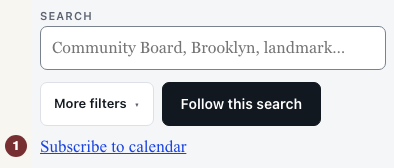

Step 4 — Add the subscription in your calendar app
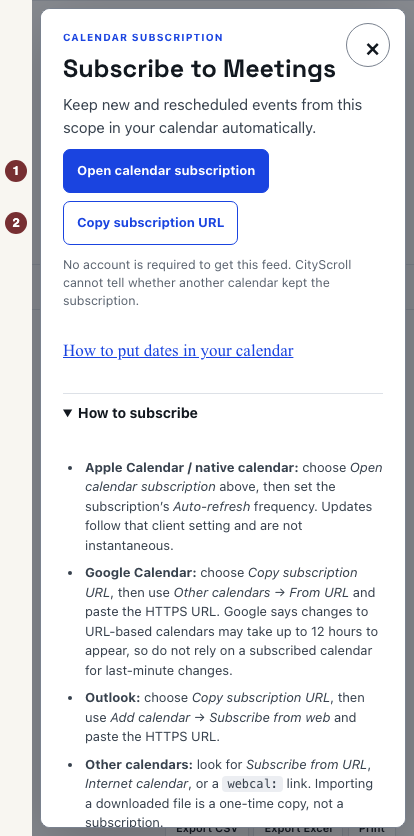
In that panel, choose the route your app supports:
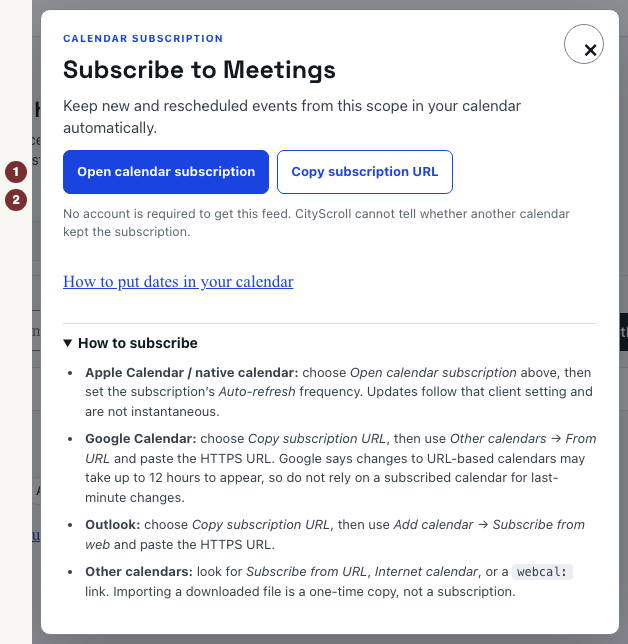
- Open calendar subscription opens your device's calendar app. Add the subscription there. In Apple Calendar, set its Auto-refresh frequency.
- Copy subscription URL copies an address. In Google Calendar, paste it under Other calendars → From URL. In Outlook, use Add calendar → Subscribe from web.
Check in your calendar app that it lists a subscribed calendar and displays the expected dates. CityScroll cannot confirm that a subscription was added or refreshed. Importing a downloaded file is a one-time copy. Only a URL your calendar keeps fetching is a subscription.
Subscriptions keep date-only deadlines as all-day entries and mark cancelled events as cancelled. Updates follow your calendar app's refresh schedule. Check the official record for last-minute changes.
When dates are missing
If Now lists an action with no published closing date, there is no deadline to export. Open Following to watch for updates instead. If a source could not be reached, the answer is unknown: reload before treating the list as empty.